 Pufferfinance
 pufETH and Ethereum infrastructure
Updated
Pufferfinance combines pufETH liquid restaking with validator infrastructure, the UniFi based rollup and Puffer Preconf services. pufETH represents restaked ETH, with rewards reflected in its redemption value. Direct redemption relies on available exit liquidity, while institutional services add distinct custody and staking arrangements.
Key takeaway: A pufETH balance can remain constant as its ETH redemption value changes, because the token accrues rewards without rebasing.
What does pufETH represent within Pufferfinance?
pufETH represents a share of ETH held through Puffer's native liquid restaking protocol, connecting token holders with Ethereum staking and restaking rewards. Deposits help fund validators participating in Ethereum consensus. Through EigenLayer, that validator stake can also secure additional services. Native restaking describes this reuse of validator ETH, which gives the token exposure to activities beyond ordinary staking.
Holding pufETH does not require operating the validator. Node operators perform that work, while the token records the holder's claim within the protocol.
The reward-bearing token does not rebase. Yield accrues through its conversion rate against ETH, so rewards need not increase the number of tokens held. In the vault accounting, deposits plus rewards minus penalties, divided by outstanding pufETH supply, determine the ETH value per token. Rewards can raise this rate; penalties can reduce it. A growing redemption value therefore requires rewards to exceed the penalties affecting the backing. Restaking operators can add service-specific rewards, while penalties from those services can also reduce the token's underlying backing.
New deposits increase the backing and token supply proportionally. They do not, by themselves, generate a higher conversion rate for existing holders.
The documented staking interface covers ETH, WETH, stETH and wstETH inputs. Those assets represent different forms of Ethereum exposure, and their conversion into pufETH must respect the selected asset's exchange rate. Deposit support, the token's ETH-denominated value and withdrawal availability describe different properties. A positive reward rate does not establish how quickly the vault can supply an exit.
Validator tickets connect operators and token holders
Validator tickets link the ETH funding Puffer's validators to the operators running them, with upfront payments compensating pufETH holders for supplying that capital.
Upfront reward payments
Each validator ticket represents one validator-day of expected proof-of-stake rewards. Operators obtain ticket coverage before running a funded validator, and payments for ticket minting benefit pufETH holders. This separates that reward contribution from the operator's later performance. Operators retain the consensus and execution rewards their validators generate, including maximal extractable value (MEV). Their earnings must cover ticket costs and operating expenses for the activity to produce a profit.
Bonds and validator safeguards
The documented operator arrangement requires a bond worth 2 ETH in pufETH alongside validator tickets. The protocol provides the 32 ETH validator funding. An unslashed exit with at least 32 ETH returns the full bond; an unslashed shortfall reduces it. The operator forfeits the entire bond if the validator is slashed. The bond absorbs validator losses before they reach the shared backing, while anti-slashing technology aims to prevent slashable behavior. In the Guardian-based design, trusted participants check registrations, coordinate exits and return eligible bonds. Permissionless operator participation therefore coexists with specific safeguards and operational responsibilities. Losses exceeding available protection can still affect pufETH holders.
Can pufETH withdrawals complete immediately?
The one-step withdrawal route can deliver WETH immediately when its liquidity vault can supply the withdrawal. Direct WETH redemption from PufferVault requires sufficient exit liquidity. The app's documented routes return WETH, the wrapped form of ETH, so the output asset matters alongside timing.
Liquidity-backed one-step withdrawals
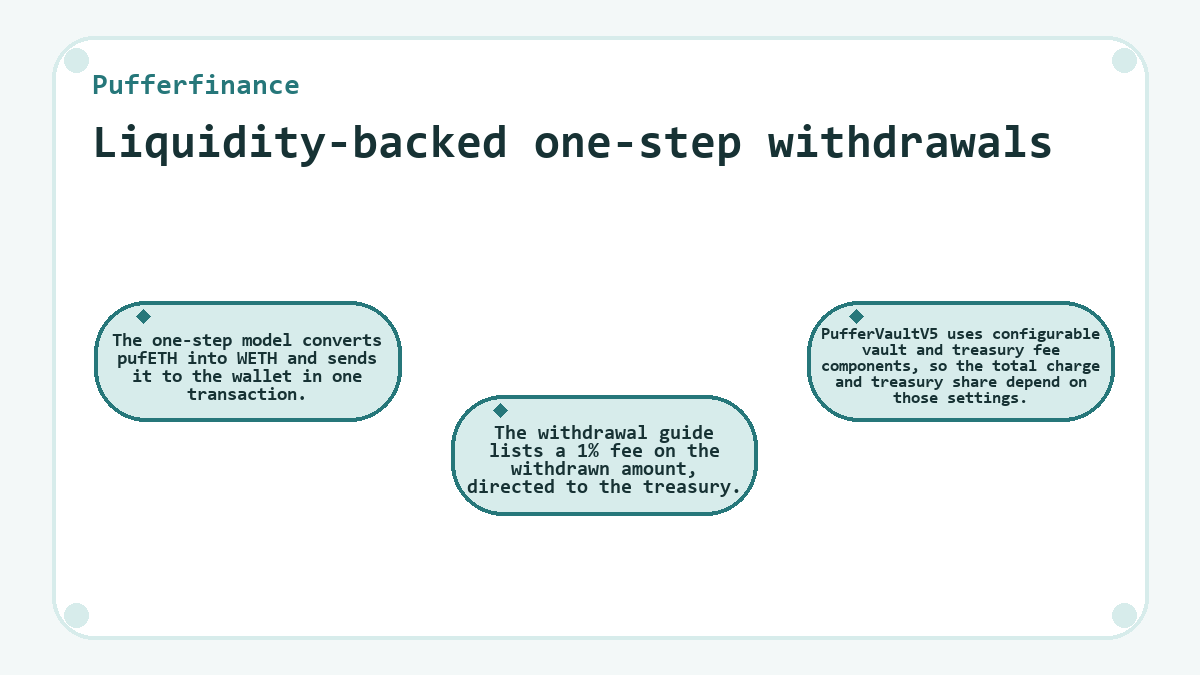
The one-step model converts pufETH into WETH and sends it to the wallet in one transaction. The withdrawal guide lists a 1% fee on the withdrawn amount, directed to the treasury. PufferVaultV5 uses configurable vault and treasury fee components, so the total charge and treasury share depend on those settings.
Batched standard withdrawals
Standard two-step withdrawals have no protocol withdrawal fee, although Ethereum transaction gas remains a separate cost. A request enters a withdrawal batch before its claim becomes available. Processing may take around 14 days when validator exits and restaking withdrawal delays are needed. Existing liquidity can shorten that wait. Requesting an exit and completing its claim are separate actions in this model.
UniFi and Preconf connect rollup execution to Ethereum
UniFi is Puffer's Ethereum Layer 2 based rollup, while Puffer Preconf supplies early execution commitments through infrastructure connected to participating Ethereum validators.
Ethereum-based sequencing
A based rollup derives transaction ordering from Ethereum's Layer 1 validators. UniFi applies that relationship to rollup execution and includes native yield in its product design. Its fast Layer 2-to-Ethereum withdrawal design uses trusted execution environment (TEE) proofs, with a documented expectation of minutes. These withdrawals move rollup assets between layers. They do not set the liquidity conditions for redeeming pufETH through PufferVault.
Execution commitments before settlement
Puffer Preconf uses gateways acting on behalf of participating validators to provide early commitments about transaction execution. An execution preconfirmation commits to a particular execution result; an inclusion preconfirmation addresses inclusion in a block. Layer 1 settlement follows the gateway's early commitment. This gives applications earlier execution information without replacing Ethereum finality. UniFi uses the service, and its broader architecture supports integrations beyond Puffer's own rollup. Preconfirmation fee sharing connects rollup operators with participating validators and gateways.
Network and protection scope
The documented public UniFi access configuration describes a testnet. Preconf's Phase 1 model supports OP-based rollups and uses reward forfeiture for missed proposals. Full slashing and user refunds belong to a later implementation phase. Reward forfeiture penalizes missed proposals without providing the later model's slashing-funded compensation.
Institutional access through custody and dedicated infrastructure
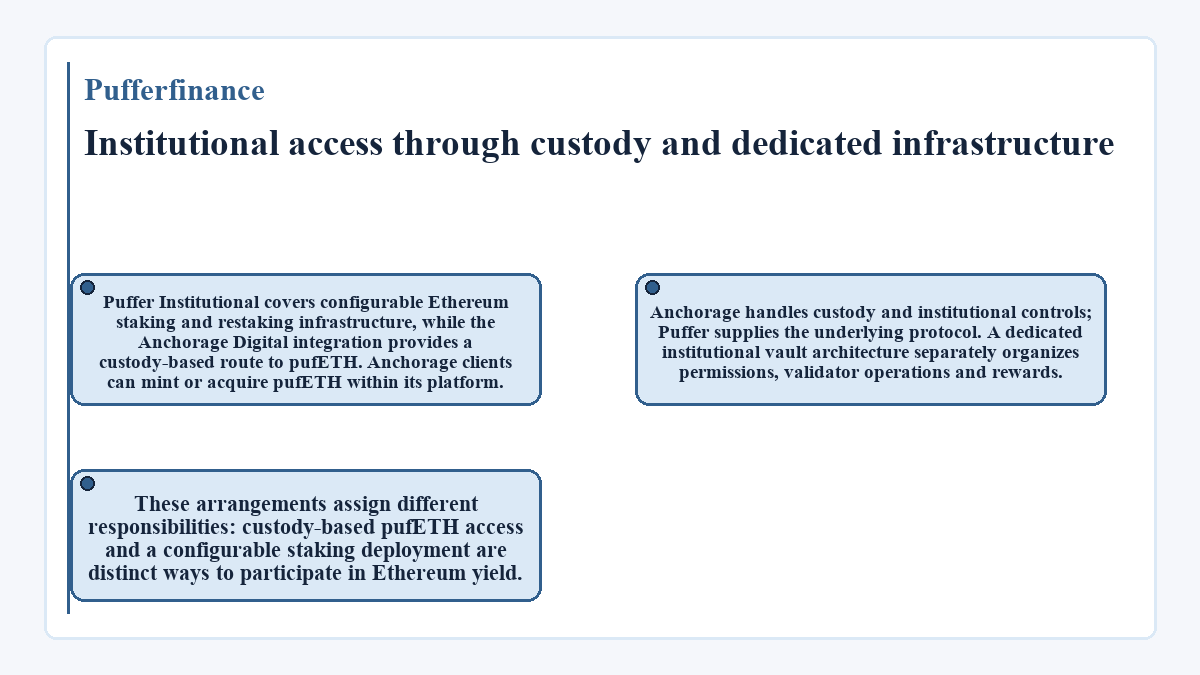
Puffer Institutional covers configurable Ethereum staking and restaking infrastructure, while the Anchorage Digital integration provides a custody-based route to pufETH. Anchorage clients can mint or acquire pufETH within its platform. Anchorage handles custody and institutional controls; Puffer supplies the underlying protocol. A dedicated institutional vault architecture separately organizes permissions, validator operations and rewards. These arrangements assign different responsibilities: custody-based pufETH access and a configurable staking deployment are distinct ways to participate in Ethereum yield.
The existing UniFi Vault withdrawal notice
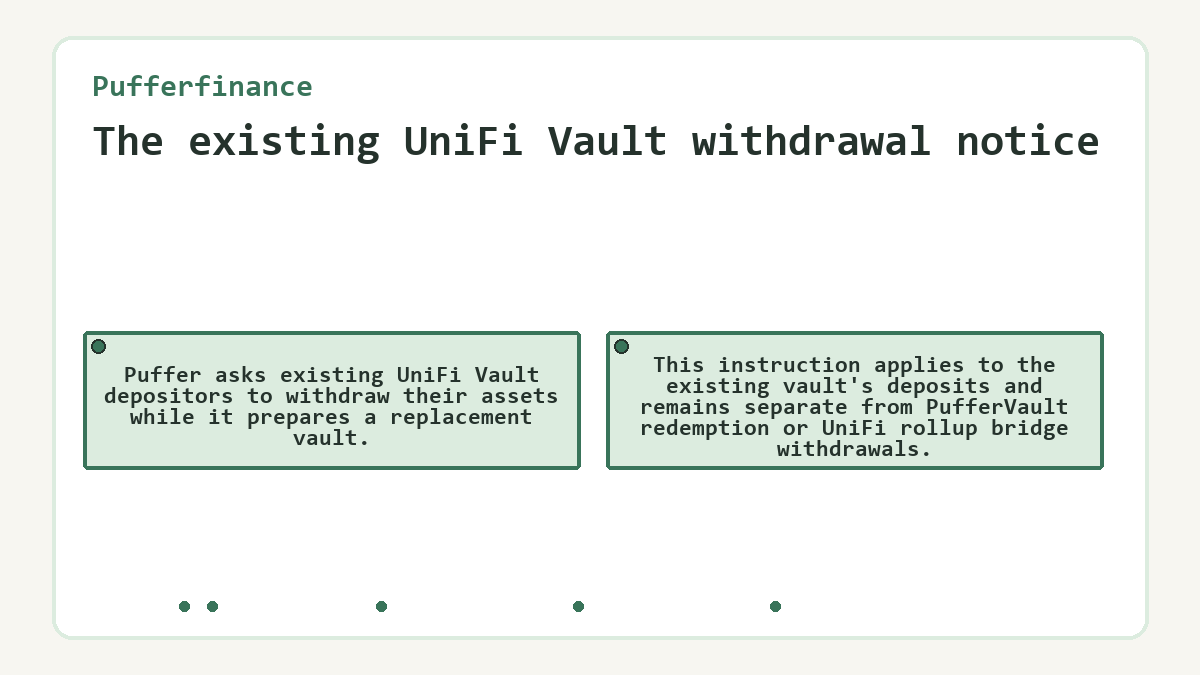
Puffer asks existing UniFi Vault depositors to withdraw their assets while it prepares a replacement vault. This instruction applies to the existing vault's deposits and remains separate from PufferVault redemption or UniFi rollup bridge withdrawals.
Choosing the relevant Puffer component
- For an ETH-denominated restaking position, pufETH represents the vault claim. Its conversion rate accounts for rewards and penalties, while available exit liquidity governs direct redemption.
- For validator operation, distinguish the bond from validator tickets. The bond buffers losses; tickets compensate token holders and define the operator's covered validator time.
- For UniFi transactions, distinguish gateway preconfirmation from Layer 1 settlement. Rollup execution and cross-layer withdrawals belong to UniFi's network and proof system.
- For Preconf integration, match the rollup architecture and protection phase. The initial OP-based model does not include the later full-slashing and refund features.
- For institutional participation, separate custodian-held pufETH from dedicated staking infrastructure. The custody arrangement and contract permissions determine who manages the relevant operations.
A fast withdrawal feature in one component does not make another component's assets immediately redeemable. The deciding limits belong to the particular vault, network or service involved.
Still wondering about Pufferfinance?
Which token standards does pufETH follow?
pufETH is a reward-bearing ERC20 token implemented through PufferVault following the ERC4626 vault standard. ERC20 covers the transferable token, while ERC4626 standardizes tokenized vault shares and their relationship to underlying assets. They do not establish whether a particular application lists pufETH or accepts it as collateral.
Does depositing WETH require the same approval as depositing ETH?
Depositing WETH requires a token-spending approval transaction, while depositing native ETH does not require that approval. The documented staking interface then requires a transaction to deposit the selected asset and receive pufETH. An approval authorizes spending; it does not itself complete the stake or mint the token.
How much pufETH does a standard withdrawal require?
The standard two-step route requires at least 0.01 pufETH per withdrawal request. PufferWithdrawalManager rejects requests below that amount. This minimum concerns the pufETH being withdrawn, not the wallet's total holdings or a fixed ETH value. It applies to that route and does not establish a minimum for every Puffer operation.
Is a governance token required to participate in Puffer Preconf?
Puffer Preconf does not require a Puffer governance token for validators, gateways or Layer 2 participation. Removing that token requirement does not remove the integration requirements. Validators and operators still need the relevant registrations, delegated validator infrastructure and compatible software. Rollup support also follows the applicable implementation phase.
Who has audited the PufferVault contracts?
PufferVault has audit reports from BlockSec, SlowMist, Quantstamp, Trail of Bits, Nethermind and Creed. The audit history includes v1 and v2 reviews. Each review applies to the code and scope it examined; an audit does not establish coverage of every later upgrade, external integration or separate Puffer product.
Why does wstETH have a different deposit conversion from ETH?
wstETH represents wrapped stETH, so its deposit conversion must account for the wrapper's exchange rate as well as the pufETH conversion rate. The documented staking interface treats wstETH separately from ETH for this calculation. Equal displayed token counts therefore do not establish equal underlying ETH values or equal pufETH output amounts.