 Pufferfinance
 validator tickets for prepaid operation and early exits
Updated
Pufferfinance validator tickets (VTs) prepay the right to operate a Puffer-funded Ethereum validator for one day per ticket. Node operators commit tickets alongside a separate bond, then retain the Proof of Stake rewards their validators produce. Beacon Chain activation starts the operating period. Early exit can still consume the configured minimum ticket commitment, even when fewer days elapse. A ticket purchase alone does not register a validator, and prepaid operating rights do not establish an operator's profit.
On this page
Ticket ownership and validator reward eligibility
Buying transferable VTs and depositing them for a node operator create different obligations and different records of participation. A purchase puts ERC20 tickets at its chosen recipient address. Registration commits tickets and collateral to a specific node operator. An activated validator produces the operator's validator rewards. Holding pufETH instead gives exposure to the pool's backing and applicable ticket proceeds, without requiring validator operation.
Guardian provisioning follows registration checks and available funding. A pending registration therefore does not establish Beacon Chain activation or a running ticket-funded period. If Guardians skip an invalid registration, the PufferProtocol implementation using PufferVaultV5 returns the pufETH bond and burns the configured VT penalty.
Fund the bond and the registration minimum
Registration requires both the applicable collateral and enough incoming VTs, so previous deposits cannot replace tickets supplied in that call. In the PufferProtocol implementation using PufferVaultV5, registration supports a 2 ETH bond without SGX enclave evidence. Its enclave-evidence path uses a 1 ETH bond. The contract can mint pufETH from an ETH-funded bond or transfer the required pufETH shares. Registration records the bond in pufETH, so its ETH value and token quantity use different units.
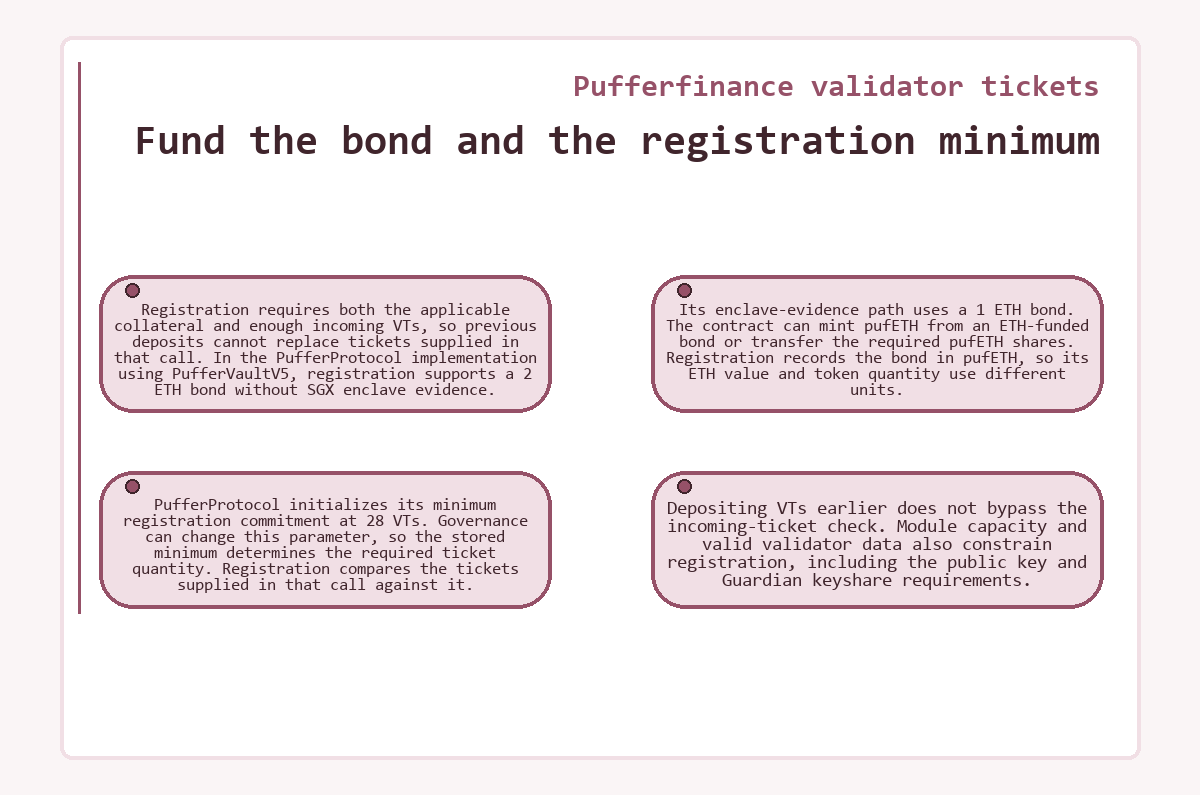
PufferProtocol initializes its minimum registration commitment at 28 VTs. Governance can change this parameter, so the stored minimum determines the required ticket quantity. Registration compares the tickets supplied in that call against it. Depositing VTs earlier does not bypass the incoming-ticket check. Module capacity and valid validator data also constrain registration, including the public key and Guardian keyshare requirements.
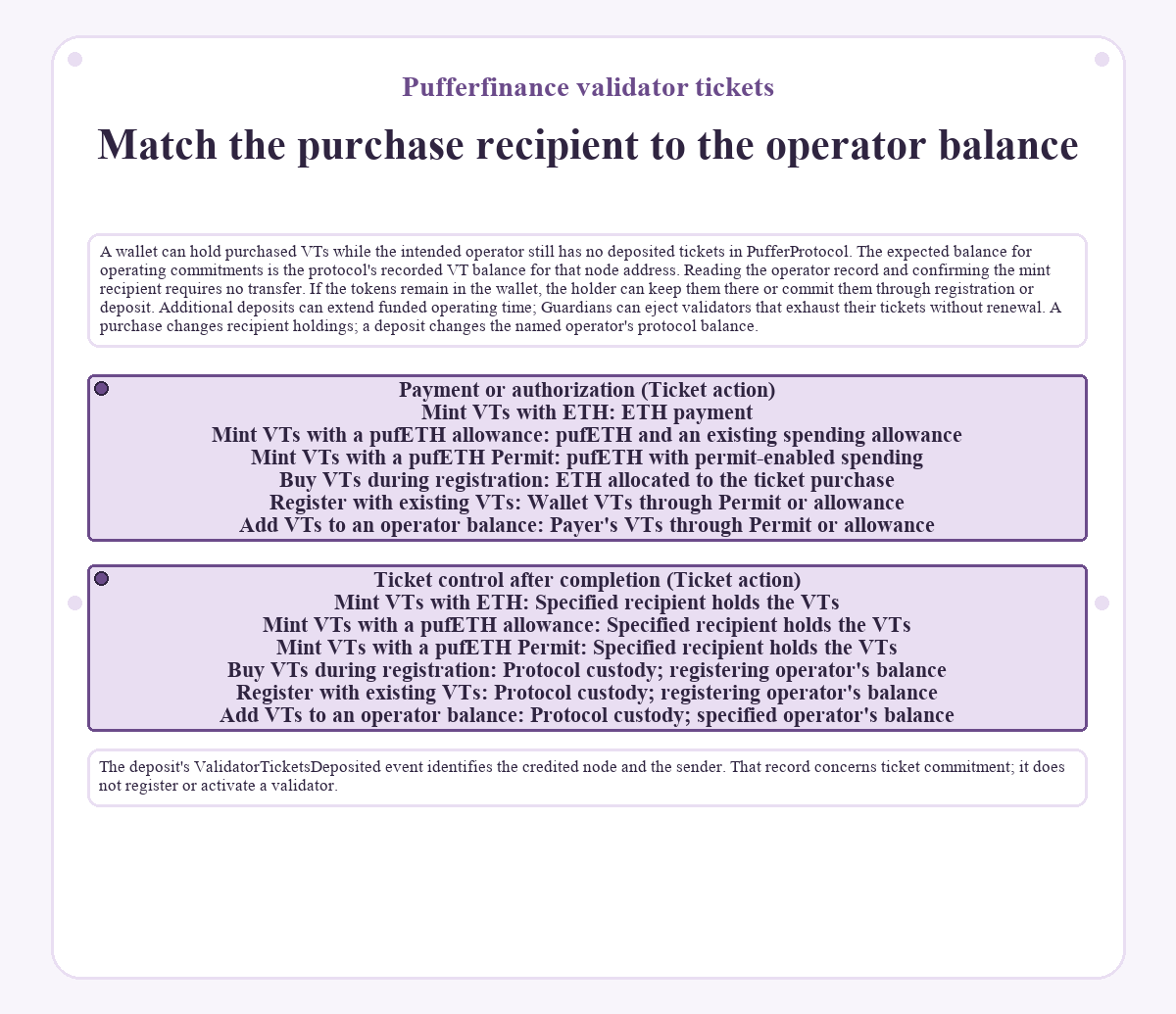
Match the purchase recipient to the operator balance
A wallet can hold purchased VTs while the intended operator still has no deposited tickets in PufferProtocol. The expected balance for operating commitments is the protocol's recorded VT balance for that node address. Reading the operator record and confirming the mint recipient requires no transfer. If the tokens remain in the wallet, the holder can keep them there or commit them through registration or deposit. Additional deposits can extend funded operating time; Guardians can eject validators that exhaust their tickets without renewal. A purchase changes recipient holdings; a deposit changes the named operator's protocol balance.
| Ticket action | Payment or authorization | Ticket control after completion |
|---|---|---|
| Mint VTs with ETH | ETH payment | Specified recipient holds the VTs |
| Mint VTs with a pufETH allowance | pufETH and an existing spending allowance | Specified recipient holds the VTs |
| Mint VTs with a pufETH Permit | pufETH with permit-enabled spending | Specified recipient holds the VTs |
| Buy VTs during registration | ETH allocated to the ticket purchase | Protocol custody; registering operator's balance |
| Register with existing VTs | Wallet VTs through Permit or allowance | Protocol custody; registering operator's balance |
| Add VTs to an operator balance | Payer's VTs through Permit or allowance | Protocol custody; specified operator's balance |
Match the purchase recipient to the operator balance
- Payment or authorization (Ticket action) Mint VTs with ETH: ETH payment Mint VTs with a pufETH allowance: pufETH and an existing spending allowance Mint VTs with a pufETH Permit: pufETH with permit-enabled spending Buy VTs during registration: ETH allocated to the ticket purchase Register with existing VTs: Wallet VTs through Permit or allowance Add VTs to an operator balance: Payer's VTs through Permit or allowance
- Ticket control after completion (Ticket action) Mint VTs with ETH: Specified recipient holds the VTs Mint VTs with a pufETH allowance: Specified recipient holds the VTs Mint VTs with a pufETH Permit: Specified recipient holds the VTs Buy VTs during registration: Protocol custody; registering operator's balance Register with existing VTs: Protocol custody; registering operator's balance Add VTs to an operator balance: Protocol custody; specified operator's balance
The deposit's
ValidatorTicketsDeposited
event identifies the credited node and the sender. That record concerns ticket commitment; it does not register or activate a validator.
How does an early exit change the ticket burn?
An early exit can consume the configured minimum ticket commitment when elapsed validator time would require fewer VTs. PufferProtocol calculates usage from recorded start and end epochs using an upward-rounded conversion into ticket units. The calculation excludes time between the ticket purchase and Beacon Chain activation.
If the operator balance covers the configured minimum, the contract applies that minimum to a smaller elapsed-time charge. Its comparison uses the value in force during exit accounting. A later governance increase can therefore affect an operator who registered under a smaller minimum.
When elapsed usage and the operator's remaining VT balance both fall below the configured minimum, PufferProtocol burns that remaining balance.
The pufETH bond follows separate loss rules. A slashed validator forfeits the full bond in this implementation. Without slashing, a returned validator balance below 32 ETH reduces the bond by the shortfall. An unslashed exit returning at least 32 ETH leaves the bond intact. These rules do not refund consumed VTs.
The
ValidatorExited
event records ticket burns and bond burns separately. Its
vtBurnAmount
identifies consumed VTs, while
pufETHBurnAmount
identifies collateral loss.
Unused VTs after the operator's last validator
Unused deposited VTs become withdrawable only after the operator has no active or pending validators in this PufferProtocol implementation. The ticket withdrawal function rejects requests while either validator count remains nonzero. Exiting one validator does not unlock the balance when another still meets either condition. The restriction applies to deposited operator tickets, not every VT the wallet owns. After those counts clear, withdrawals remain subject to PufferProtocol's access controls and the available recorded ticket balance.
Oracle pricing and the cost of an operating day
The oracle's VT quote determines purchase cost, while actual validator performance determines the operator's earned reward income. The pricing model relates expected daily validator revenue to a discount: ticket price equals expected daily revenue multiplied by one minus the discount. Consensus income and execution income, including MEV, inform that expectation. Neither the model nor prepaid operating rights supply a fixed realized margin. Hardware costs and ticket consumption still affect profitability.
ETH-funded minting divides the payment by the oracle ticket price to determine the minted amount. Integer arithmetic rounds down the resulting token units. A pufETH-funded purchase takes the requested VT amount, calculates its ETH cost and converts that value into pufETH shares with upward rounding. The pufETH conversion rate can change the share quantity required for the same ticket commitment. The ticket purchase cost is separate from the refundable bond and transaction gas.
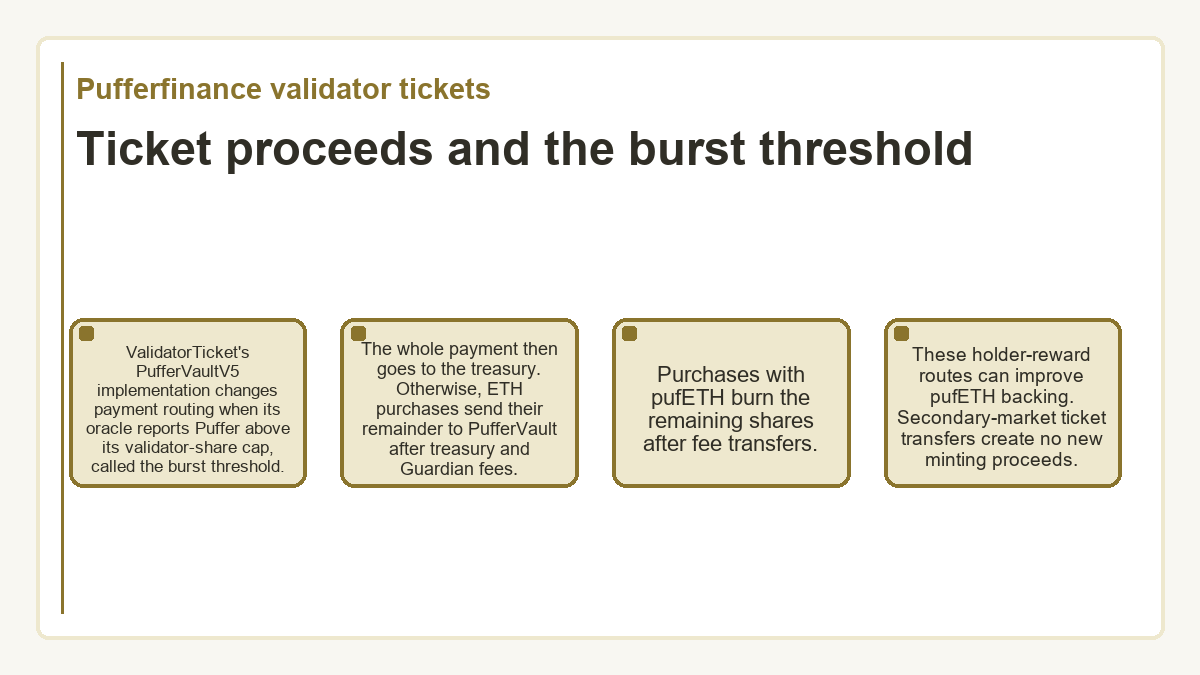
Ticket proceeds and the burst threshold
ValidatorTicket's PufferVaultV5 implementation changes payment routing when its oracle reports Puffer above its validator-share cap, called the burst threshold. The whole payment then goes to the treasury. Otherwise, ETH purchases send their remainder to PufferVault after treasury and Guardian fees. Purchases with pufETH burn the remaining shares after fee transfers. These holder-reward routes can improve pufETH backing. Secondary-market ticket transfers create no new minting proceeds.
Ticket commitments alongside restaking and reward claims
VTs cover Ethereum validator operating time, while a chosen restaking module defines additional participation beyond that ticket commitment. Modules can delegate validator ETH to restaking operators supporting Actively Validated Services, or AVSs. Module eligibility and allowed AVSs remain separate from the VT balance. Buying or depositing VTs alone does not establish enrollment in every AVS.
Operator reward claims recover earned income; ticket withdrawals recover available unconsumed VTs. pufETH withdrawals redeem token shares for underlying assets. Those actions concern different balances and permissions. An available reward claim therefore does not unlock committed tickets. An operator accounting for an exit must distinguish claimed rewards from remaining VTs and the returned pufETH bond.
Everyday questions about Pufferfinance validator tickets
Can another address add VTs to my node operator balance?
Another address can deposit VTs into a specified node operator's recorded balance. The deposit function transfers tokens from the transaction sender and credits the named node. Supplying tickets does not make the payer the node operator or give them authority to withdraw that operator's balance. The deposit needs valid spending authorization.
Which authorization allows PufferProtocol to transfer my wallet-held VTs?
A VT Permit signature or an existing token allowance can authorize PufferProtocol to transfer wallet-held tickets. The registration and deposit functions attempt the Permit before transferring tokens. A Permit includes the spender, amount and deadline. Its signature grants spending permission; a successful transaction commits the tickets. Signing alone does not establish a deposited balance.
Are VT purchase fee rates fixed?
Governance can change the treasury and Guardian fee rates in the ValidatorTicket implementation using PufferVaultV5. Each configured rate has a 10% cap. When the oracle does not report Puffer above its validator-share cap, ETH purchases pay fees in ETH. The pufETH path sends fee shares in pufETH, with the Guardian portion going to the Operations Multisig.
Why does the VT minimum use the Solidity 'ether' suffix?
The Solidity ether suffix scales the VT token quantity into 18-decimal units. In PufferProtocol's initializer, 28 ether denotes 28 VTs, not a 28 ETH payment. Ticket cost comes from the VT quantity and the ETH-denominated oracle price. The bond remains a separate collateral amount, even when one registration transaction funds both commitments.
How do ticket top-ups cover several validators under one node operator?
Depositing additional VTs increases the operator's shared protocol balance. PufferProtocol tracks that balance for the node address. Exit accounting charges each exiting validator's elapsed-time usage and applies the minimum-commitment rule where necessary. Each ticket represents one validator-day, so the shared balance must cover the separately calculated consumption of the operator's validators.