 Pufferfinance
 withdrawals depend on vault liquidity for instant WETH payouts and batch processing for queued claims
Updated
Pufferfinance withdrawals convert pufETH into WETH, with immediate redemption limited by available vault liquidity. A standard withdrawal queues the tokens and requires a later claim after batch processing. Low liquidity can require validator exits and EigenLayer withdrawals before the payout becomes available. The two routes also differ in protocol charges, transaction requirements and the calculation of the final amount. A successful request transaction establishes a pending withdrawal; completion delivers WETH to the recipient wallet.
pufETH shares, vault liquidity and WETH payments
PufferVault accounts for the ETH backing pufETH and supplies liquid assets for redemption, while the app returns WETH to the withdrawing staker. WETH is the wrapped form of ETH. The pufETH quantity identifies the shares surrendered, while the WETH amount identifies the payment. Those quantities use different units and need the applicable conversion rate. A token balance alone cannot reveal how much can leave immediately.
ETH supporting pufETH can already fund Ethereum validators and participate in restaking. That capital contributes to token backing even while it remains unavailable for immediate payment. A conversion quote values the shares; liquid vault assets fund the exit. Reading these figures separately explains how a backed token balance can coexist with a limited instant withdrawal.
Queued requests link vault shortages to validator exits
Standard requests let the protocol gather withdrawal liquidity through batch processing, including validator exits when liquid assets cannot cover requested payouts. The backend processes batches periodically. A shortage can therefore add underlying withdrawal dependencies before the request becomes claimable.
Liquidity already inside the vault
Available liquid funds can cover a standard withdrawal without removing validators. Processing can then take substantially less time than an exit requiring capital from the Beacon Chain. The request still requires standard batch processing and a later claim.
Capital released through validator exits
Ethereum validator exits
The documented exit process uses a voluntary exit message to remove a validator from the Beacon Chain. Each validator provisioned under this Puffer design receives 32 ETH. The protocol may need several exits when requests exceed the capital one validator can release.
EigenLayer withdrawal queues
Restaked capital also follows EigenLayer withdrawal processing. Removing a validator and recovering usable funds involve separate dependencies. A request remains subject to those processes when the vault needs their liquidity.
Why can a pufETH balance exceed the amount available for immediate withdrawal?
Your pufETH balance represents shares in the backing pool, while immediate withdrawal capacity reflects the liquid funds the vault can currently supply. Assets funding validators do not become spendable WETH simply because the token has a redemption value. A positive balance and a positive conversion quote therefore answer different questions from the immediate withdrawal maximum.
PufferVaultV5 limits direct withdrawals using available ETH and WETH liquidity.
Its owner-specific maximum also accounts for the wallet balance and applicable fee calculations.
maxWithdraw
reports asset units, while
maxRedeem
reports pufETH share units. These limits describe direct vault calls in that implementation. They do not establish when an outstanding standard request will finish processing.
An instant quote above the withdrawal limit
Assume hypothetical figures: a pufETH balance has a fee-adjusted redemption quote of 2.347 WETH, while the owner-specific direct-withdrawal maximum is 1.817 WETH. The question is whether the full quoted amount can leave immediately. Both figures describe WETH amounts, so they support a direct comparison.
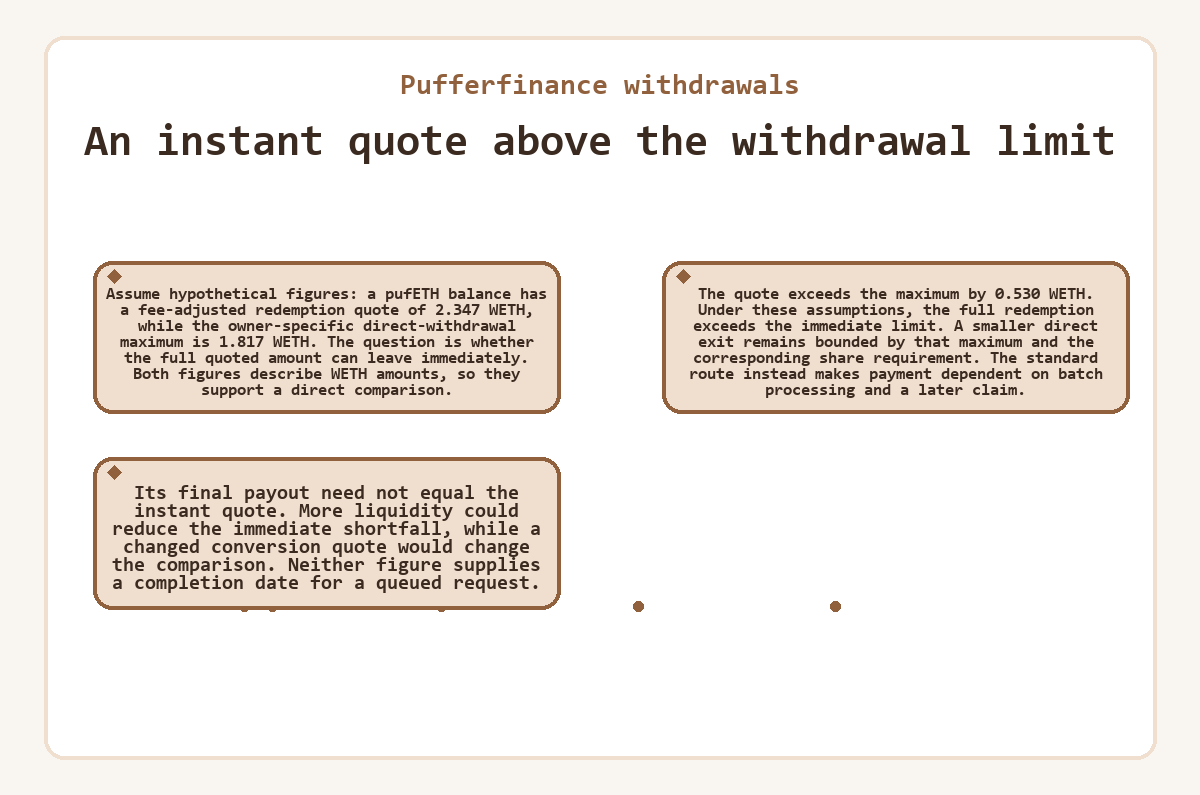
The quote exceeds the maximum by 0.530 WETH. Under these assumptions, the full redemption exceeds the immediate limit. A smaller direct exit remains bounded by that maximum and the corresponding share requirement.
The standard route instead makes payment dependent on batch processing and a later claim. Its final payout need not equal the instant quote. More liquidity could reduce the immediate shortfall, while a changed conversion quote would change the comparison. Neither figure supplies a completion date for a queued request.
Withdrawal fees and Ethereum transaction costs
The documented one-step app flow includes a 1% fee on the withdrawal amount, while the standard flow avoids that protocol withdrawal charge. The fee figure belongs to that app description; the deployed vault settings determine the executable quote. PufferVaultV5 combines a vault exit charge with a treasury charge;
getTotalExitFeeBasisPoints
reports their sum. An assumed percentage can therefore misstate the net output when the applicable configuration differs.
Ethereum transaction gas remains a separate expense for both withdrawal modes. A Permit signature authorizes token spending without an on-chain transaction, so signing it alone incurs no gas.
The documented instant app flow uses one transaction. Creating the request and completing the later claim each require a transaction in the documented app flow. Gas expenditure therefore depends on those transactions and network conditions. A comparison should use the WETH received after applicable protocol charges alongside the ETH spent on gas.
Batch processing controls the wait for WETH
The standard flow gives an approximate 14-day processing period when withdrawal liquidity requires validator exits and EigenLayer queues. Existing vault liquidity can shorten the wait because the protocol may avoid removing validators. In the published PufferWithdrawalManager, a batch must contain the required number of requests before an authorized caller can finalize it. Available liquidity alone does not make a request claimable. The approximate period does not establish a guaranteed arrival date for every request. A pending claim can indicate a withdrawal request awaiting batch processing without showing which underlying dependency remains. The relevant completion condition is a processed withdrawal batch followed by the claim transaction. Elapsed time alone cannot establish whether that batch has finished.
Conversion rates determine the settled claim amount
A queued withdrawal commits pufETH shares before settlement determines the WETH payment, so a displayed estimate and the completed payout need not match. Rewards can increase the ETH backing per share when they exceed penalties. Losses can reduce it. Validator tickets influence the pool economics, but their reward mechanism does not itself establish the amount a particular queued withdrawal will receive.
PufferWithdrawalManager stores a conversion rate when a request enters the queue. Completion uses the lower of that rate and the batch-finalization rate. Later rate growth leaves the request capped at its recorded rate; a lower settlement rate reduces its payout. This rule belongs to that manager implementation. It explains why multiplying the queued shares by a later, higher headline rate can overstate the payment.
Authorization, pending requests and completed payouts
The app's Permit signature authorizes pufETH spending, while separate transactions create the withdrawal request and complete the later WETH claim. Signing successfully can therefore leave the withdrawal unfinished.
Permit authorization
The documented app flow starts with a Permit signature allowing the protocol to spend pufETH. The signature authorizes the transfer required for the request. It does not itself transfer WETH or create the request transaction. Its token, spender and amount describe the authorization the wallet grants.
The submitted request
The request transaction transfers pufETH into the protocol for processing. The app then displays the request under Withdrawal Claims. That entry identifies a withdrawal awaiting its batch. A successful request transaction confirms submission, while the later batch status determines whether the claim can proceed.
The completed WETH payment
After batch processing, the documented app flow requires a claim transaction to complete the withdrawal. The claim transaction transfers the WETH payout to the wallet. A successful claim transaction and its WETH transfer to the recipient establish payment. The pending portfolio entry represents an earlier state.
Version-specific limits constrain different withdrawal amounts
A withdrawal limit belongs to its contract and unit: pufETH request limits, WETH redemption limits and older daily counters constrain different operations. PufferVaultV5 exposes liquidity-dependent direct withdrawal and redemption maxima. The published PufferWithdrawalManager exposes a configurable maximum request amount in pufETH and rejects larger requests. A request-size ceiling does not measure available instant liquidity, and neither quantity fixes a queue duration. The selected mode must satisfy its own amount constraints.
PufferVaultV2 applies a daily assets-withdrawal limit. That version-specific rule does not establish a daily reset for every later vault implementation.
The documented standard app mode requires at least 0.01 pufETH per withdrawal request. This threshold measures the submitted shares, so it does not promise 0.01 WETH of output. The applicable conversion rate determines their underlying value. Increasing a request beyond the minimum also does not bypass its configured maximum or the liquidity needed for settlement.
Staker redemptions, operator exits and UniFi withdrawals
Staker redemptions exchange pufETH for WETH, while a node operator's validator exit releases validator capital and triggers separate bond accounting. Validator tickets track the operator's prepaid operating commitment, with their own exit consequences. Claiming node operator consensus rewards on Base instead delivers pufETH through a reward-distribution channel. That reward claim does not complete a staker withdrawal from the Ethereum vault. These operations involve different balances and recipients.
Puffer's notice for the existing UniFi Vault asks holders to withdraw ahead of a replacement vault. Its instruction applies to assets held in that vault. UniFi rollup withdrawals concern movement from Layer 2 to Ethereum Layer 1. Their withdrawal timing does not establish an instant exit for pufETH. A standard liquid-restaking redemption continues to follow its own liquidity, batch processing and claim conditions.
Pufferfinance withdrawals: what people ask
-
Does selling pufETH count as a protocol withdrawal?
- Selling pufETH transfers the token to another market participant; protocol withdrawal redeems shares for assets from Puffer's withdrawal infrastructure. The payment asset and price of a sale belong to that trade. A secondary-market sale does not inherit the app's standard-withdrawal timing or protocol fee treatment.
-
Which asset will I receive if I originally deposited stETH or wstETH?
- The documented staker-withdrawal flow returns WETH, including when the original deposit used stETH or wstETH. Both the one-step and standard modes return WETH.
-
Could a validator exit consume the operator's entire bond?
- A slashed Puffer validator causes its node operator to forfeit the entire bond posted for that validator. An unslashed exit returning less than 32 ETH charges the shortfall against that bond. An unslashed exit returning at least 32 ETH returns the full bond after exit processing.
-
Are PufferVaultV2 daily withdrawal allowances separate for each wallet?
- PufferVaultV2 applies one daily assets-withdrawal counter to the vault. Each wallet's balance also limits its individual withdrawal. Changing wallet addresses leaves that shared counter unchanged. The returned maximum therefore combines vault-wide daily capacity with the withdrawing owner's redeemable balance.
-
Who can change the vault's withdrawal fee?
- Authorized protocol governance can change vault fees through restricted contract setters. A displayed fee represents an applicable configuration, not an immutable token property. Changes to that configuration can alter the cost of subsequent direct redemptions without changing the number of pufETH shares already held.
-
Can I redeem pufETH after depositing into PufferVaultV5 in the same transaction?
- PufferVaultV5 rejects a direct withdrawal or redemption if a vault deposit occurred earlier in the same transaction. Withdrawing or redeeming before depositing does not trigger this deposit-tracking check. This rule concerns that vault implementation and transaction boundary, rather than a waiting period expressed in days.
-
Do dedicated institutional vaults also pay withdrawals in WETH?
- The dedicated institutional vault design supports native ETH withdrawals and uses institutional share tokens representing deposits into that vault. Its output rule differs from the app's pufETH-to-WETH staker redemption. A position held through an institutional vault therefore follows that vault's asset and withdrawal arrangements.
-
May one transaction create several standard withdrawal requests?
- PufferWithdrawalManager permits one withdrawal request per transaction in the published implementation. Its request-processing guard rejects another request within the same transaction. This restriction concerns request creation through that manager; batching requests for later settlement follows a separate rule.